What bakuchiol is: a meroterpene from Psoralea corylifolia
Bakuchiol is a single plant molecule, a meroterpene, most commonly extracted from the seeds and leaves of Psoralea corylifolia, the plant known in India as babchi (Nizam et al., F1000Research, 2023).
It is often called a "plant retinol", but chemically it is not one. A 2024 review puts it plainly: "Despite lacking structural similarities with retinoids", bakuchiol "has the ability to perform similar functions" (Springer review, 2024). That functional overlap, with a different structure, is why researchers became interested in it for skin.
From babchi seed to serum: sourcing, psoralens and purity
Babchi has a long history in traditional medicine in India and China. For a skin care ingredient, though, what matters is what is left in the bottle after extraction.
- Purity. Babchi seeds also contain other compounds, including psoralens. The 2024 review describes a supercritical CO2 extraction that gives a bakuchiol-rich extract "with a lower percentage of psoralens and isopsoralen" (Springer review, 2024). Ask a brand whether it uses a purified bakuchiol, not a crude seed extract.
- Authenticity. The same review notes the plant "faces endangerment" and that authenticity testing is needed against look-alike species (Springer review, 2024).
- Light. A 2023 review states that, unlike retinoids, bakuchiol "can be used daily due to its photostability", and still recommends sunscreen alongside it (Nizam et al., 2023).
What the bakuchiol research shows: the 2019 retinol trial and smaller studies
- 2019 · Randomised trial
A prospective, randomised, double-blind study of 44 adults with facial photo-ageing. One group used 0.5% bakuchiol cream twice daily, the other 0.5% retinol cream once daily, for 12 weeks. Both significantly decreased wrinkle surface area and hyperpigmentation, with no statistical difference between them; the retinol users reported more facial scaling and stinging (Dhaliwal et al., Br J Dermatol, 2019).
- Other human studies
The 2024 review lists further small studies: a 1.5% bakuchiol serum with vanilla extract in 43 women over 56 days, a 0.5% bakuchiol cream against its base cream in 34 people, and a 12-week twice-daily 0.5% study in 16 people (Springer review, 2024).
- Laboratory work
In laboratory tests described in the same review, bakuchiol and retinol were compared side by side on collagen-related measures (Springer review, 2024). Laboratory results explain interest in a molecule; they are not results on faces.
The limits of bakuchiol: one trial, small numbers, a specific dose
Promising is not the same as proven
One head-to-head trial. The comparison with retinol rests mainly on a single study of 44 people. The other human studies are smaller still, and much of the mechanism work is in the laboratory or in animals (Nizam et al., 2023).
A specific dose and routine. The trial used 0.5% bakuchiol in a cream, twice a day, for 12 weeks. A serum with a different strength, base or routine is not repeating that study, and should not borrow its results.
Gentler is not "no reaction". The 2023 review notes that redness and peeling can occur in sensitive skin (Nizam et al., 2023). Patch-test, and start slowly.
Photostable does not mean sun-proof. Bakuchiol does not protect your skin from the sun. Morning sunscreen stays essential.
So what can a bakuchiol serum honestly do? Based on what is published: bakuchiol is a well-tolerated night ingredient with early, encouraging human data on the look of fine lines and uneven tone. Treat promises beyond that with care.
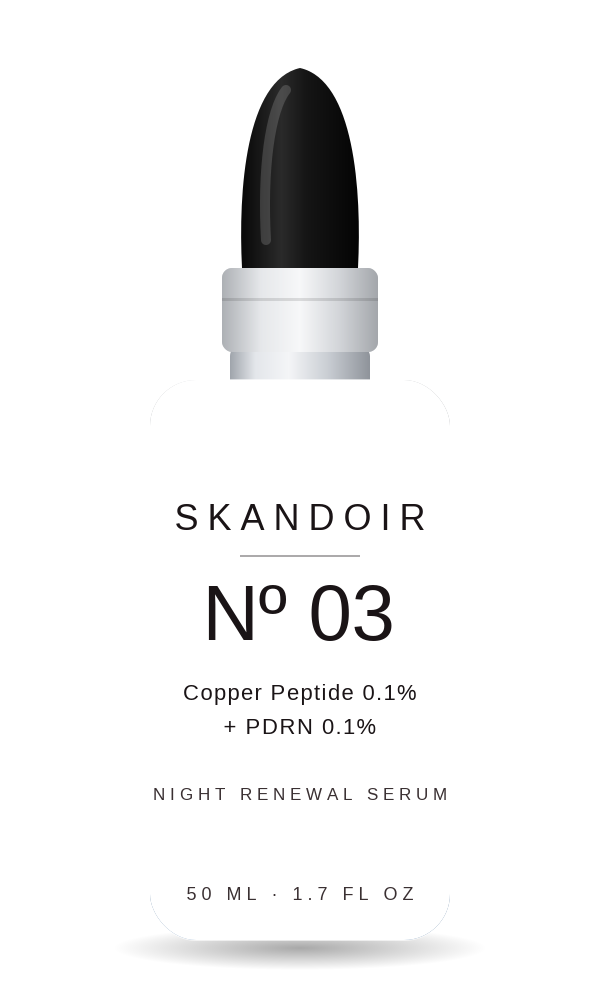
Bakuchiol next to copper peptide and PDRN in Skandoir Nº 03
In Nº 03 · Copper Peptide 0.1% + PDRN 0.1%, the Night Repair Serum, bakuchiol is a supporting ingredient. It is not the headline and we do not state a strength for it, so we do not borrow the 0.5% trial's results.
| Layer of the formula | On the INCI list | What it is there for |
|---|---|---|
| Headline actives | Copper Tripeptide-1 (0.1%), Sodium DNA (PDRN, 0.1%) | The copper peptide gives the serum its own blue tint; PDRN is skin conditioning |
| Supporting actives | Adenosine, Bakuchiol | Night-time skin care ingredients with published human studies |
| Hydration | Glycerin, Betaine | Hold water in the outer layer of the skin |
Why bakuchiol, and why at night
- Comfort first. Deeper Indian skin tones can mark for months after irritation, so we chose a night ingredient with a record of good tolerance.
- Simple evenings. 2–3 drops on clean, dry skin, then moisturiser. Do not use vitamin C (ascorbic acid) in the same step, and patch-test before first use.
- Fragrance-free. Nº 03 is a light serum with no added fragrance, for humid Chennai nights.
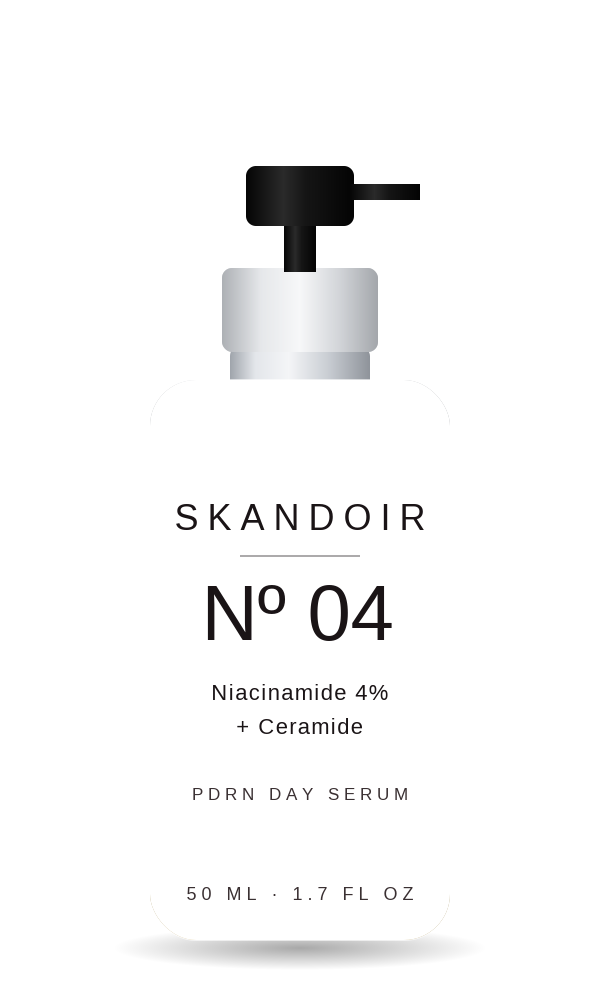
Nº 03 comes in 50 ml frosted matte-silver glass with a dropper. Proposed MRP ₹2,900, inclusive of all taxes. In the morning, the ritual moves to Nº 04 · Niacinamide 4% + Ceramide under sunscreen. All the serums are side by side on Skandoir serums compared, and more molecules are explained in The Skandoir Lab.
How to judge a bakuchiol serum
- Is it bakuchiol, or a babchi extract? "Bakuchiol" on the INCI list is the purified molecule. A crude seed extract is a different ingredient.
- Where is it on the list, and is a strength stated? The best-known trial used 0.5%. Near the end of the list means a supporting role. Both can be honest, as long as the claims match.
- Do the claims match the studies? "Compared with retinol in one trial" is fair. "Better than retinol" or "instant results" is not what the research says.
- Is it fragrance-free? Helpful at night, and if your skin reacts easily.
- Will you wear sunscreen the next morning? Any night routine aimed at uneven tone only makes sense with daily sun protection.
Pregnant or breastfeeding? Ask your doctor before starting any new active, including bakuchiol.
Bakuchiol in skincare: questions and answers
What is bakuchiol in skincare?
Bakuchiol is a plant molecule, a meroterpene, extracted mainly from the seeds of babchi (Psoralea corylifolia). In skin care it is used as a gentle night ingredient. On a label it appears as Bakuchiol.
Is bakuchiol a natural retinol?
No. It has a different chemical structure from retinoids. Researchers describe it as performing some similar functions, which is why it is often called a retinol alternative.
Is bakuchiol as good as retinol?
In one 12-week randomised trial of 44 adults, 0.5% bakuchiol cream twice daily and 0.5% retinol cream once daily gave similar results on wrinkle area and pigmentation, with less scaling and stinging for bakuchiol. It is one small study, not a final verdict.
Can I use bakuchiol in the day?
A 2023 review describes bakuchiol as photostable, so it can be used daily, but it does not protect from the sun. Skandoir uses it in the night serum Nº 03; by day, use sunscreen.
Is bakuchiol safe for sensitive skin?
It is generally described as well tolerated, but redness and peeling can occur in sensitive skin. Patch-test any new product, start slowly, and ask your doctor first if you are pregnant or breastfeeding.
Which Skandoir product contains bakuchiol?
Bakuchiol is in Skandoir Nº 03 Night Repair Serum (Copper Peptide 0.1% + PDRN 0.1%), alongside adenosine, betaine and glycerin. It is a supporting ingredient, and no strength is stated for it.
Sources for this Bakuchiol in skincare article
- Dhaliwal S, et al. Prospective, randomized, double-blind assessment of topical bakuchiol and retinol for facial photoageing. British Journal of Dermatology, 2019; 180(2):289–296.
- Nizam NN, Mahmud S, Ark SMA, Kamruzzaman M, Hasan MK. Bakuchiol, a natural constituent and its pharmacological benefits. F1000Research, 2023; 12:29 (version 2).
- Review of bakuchiol in the cosmetic and pharmaceutical industries (Springer, 2024; doi:10.1007/s11101-024-09926-y).
This page is educational and is not medical advice. Skandoir serums are cosmetics; they are not intended to treat any condition. For skin or hair disease, see a doctor.
Last reviewed: 5 November 2026