What GHK-Cu (copper tripeptide-1) is
GHK is a tripeptide — three amino acids in a row: glycine, histidine and lysine. GHK-Cu is that peptide holding one copper ion.
GHK binds copper(II) very tightly through three nitrogen atoms, leaving a fourth position open, and forms a one-to-one complex (Bossak-Ahmad et al., Int J Mol Sci, 2020). The body makes it too: a 2018 review gives plasma levels of about 200 nanograms per millilitre at age 20, falling to about 80 by age 60 (Pickart & Margolina, 2018).
On a cosmetic ingredient list it appears as Copper Tripeptide-1. The EU cosmetic ingredient database gives it one function, skin conditioning, and lists it as synthetic in origin (COSMILE Europe).
Why a copper peptide serum is blue
Copper(II) complexes absorb light in the orange-red part of the spectrum. The copper–GHK complex has its absorption band near 605 nanometres (Bossak-Ahmad et al., 2020), so what reaches your eye is the opposite colour: blue.
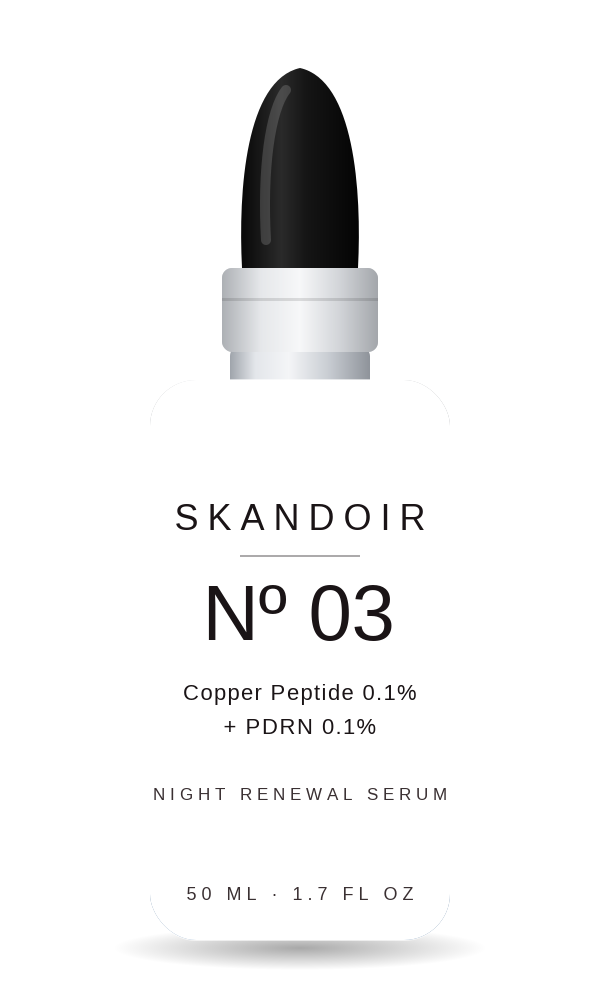
That is why a genuine GHK-Cu serum has a natural copper-blue tint without any dye, and why the shade deepens with strength. Skandoir Nº 03 has no colourant at all; the blue you see is the copper peptide at 0.1%.
A blue serum is not automatically a copper peptide serum — dyes exist. Check the ingredient list for Copper Tripeptide-1.
A short history of GHK-Cu
- 1973 · USA
Loren Pickart describes a tripeptide in human plasma for his doctoral research; it is later identified as GHK, with a strong affinity for copper (Pickart & Margolina, 2018).
- 1980s–2000s
Laboratory and animal studies of GHK-Cu in wound and tissue models, followed by copper peptide creams in cosmetics (same review).
- 2011 · USA
A University of California study measures how a copper tripeptide moves through human skin layers in the lab (Hostynek, Dreher & Maibach, Inflammation Research, 2011).
- 2018
A review links GHK to changes in the activity of a large share of human genes, using the Broad Institute's Connectivity Map data (Pickart & Margolina, 2018).
- 2025 · Poland
Analytical chemists ask how to measure whether liposome-encapsulated GHK-Cu really permeates skin — and find the question has had little attention (Ogórek et al., Molecules, 2025).
What the copper peptide research shows
The 2018 review by Pickart and Margolina summarises small cosmetic studies of GHK-Cu creams applied to the face, eye area and thigh skin over 8 to 12 weeks, in groups of women with photo-aged skin, with outcomes such as skin density and thickness, fine lines and collagen measured in biopsies. One was a randomised, double-blind comparison against its carrier alone (Pickart & Margolina, 2018).
Three things are worth knowing before you read any copper peptide marketing:
- Much of the human evidence is small and old. Several studies in the review are conference presentations or company data rather than full peer-reviewed trials, and sample sizes are often not given.
- The authors are part of the story. The review's authors work for a skin-biology company in Bellevue, Washington; Loren Pickart is the scientist who first described GHK. The review declares no external funding and no conflict of interest. We mention it because you should know who writes the research you read.
- The gene data is computational. The headline that GHK "changes thousands of genes" comes from a database of cell-line responses, not from skin of people using a serum.
Skandoir serums are cosmetics. We describe this research as history and do not quote its percentages as a promise about Nº 03.
Does GHK-Cu get into skin? The vehicle question
Small peptide, hard barrier
GHK-Cu is small for a peptide, but it is water-loving, and the skin's outer layer is built from lipids. A 2025 review puts it plainly: GHK-Cu "is a fairly hydrophilic compound with limited permeation through the lipophilic stratum corneum" (Ogórek et al., 2025).
It does move, slowly. In the University of California study, a 0.68% copper tripeptide solution kept on dermatomed human skin for 48 hours delivered copper through the skin and left a larger depot inside it (Hostynek et al., 2011). That was a lab model with the solution left on continuously — not a few drops of serum on a face.
Liposomes are one of the main ideas for helping it along: GHK-Cu encapsulates well in them, but the 2025 review notes that how such liposomes carry it into skin has "received little attention" (Ogórek et al., 2025).
How Skandoir uses copper peptide in Nº 03
Copper peptide is the hero of one Skandoir serum, and its strength is on the front of the bottle: Nº 03 · Copper Peptide 0.1% + PDRN 0.1%, the night serum for the face.
- 0.1% Copper Tripeptide-1 — enough to give the serum its natural copper-blue, with no dye.
- With PDRN 0.1%, adenosine and bakuchiol — supporting actives in a light, fragrance-free serum.
- Kept away from what pulls copper off the peptide — no acidic vitamin C (ascorbic acid) and no strong chelating agents in the formula.
- Frosted glass in a rigid box — keep the bottle in its box, away from sunlight.
Use Nº 03 at night on clean, dry skin: 2–3 drops over face and neck, then moisturiser. Do not layer it with a vitamin C (ascorbic acid) serum in the same step. All four serums are side by side on Skandoir serums compared.
How to judge a copper peptide serum
- Look for Copper Tripeptide-1 on the list — and ideally its percentage. "Peptide complex" can mean anything.
- Expect a blue tint. Real GHK-Cu colours the serum; a colourless "copper peptide" serum is worth a question.
- Check its neighbours. Ascorbic acid or strong chelators in the same bottle work against the copper complex.
- Ask about the vehicle. A water-loving peptide needs a well-built base that keeps it stable and lets it reach the skin — not just a higher number.
- Give it time and patch test. The cosmetic studies ran 8 to 12 weeks. Stop if you see irritation.
Copper peptide (GHK-Cu) in skincare: questions and answers
What is GHK-Cu?
GHK-Cu is copper tripeptide-1: the peptide glycine-histidine-lysine bound to one copper ion. It was first described in human plasma in 1973 and is used in cosmetics as a skin-conditioning ingredient.
Why is copper peptide serum blue?
Copper(II) complexes absorb orange-red light, so they look blue. The copper–GHK complex absorbs near 605 nm. Skandoir Nº 03 is blue from its 0.1% copper peptide alone, with no dye.
Can I use copper peptide with vitamin C?
Not in the same step. Acidic vitamin C (ascorbic acid) can interfere with the copper complex. Use Skandoir Nº 03 at night and keep vitamin C for the morning.
Can I use copper peptide with niacinamide?
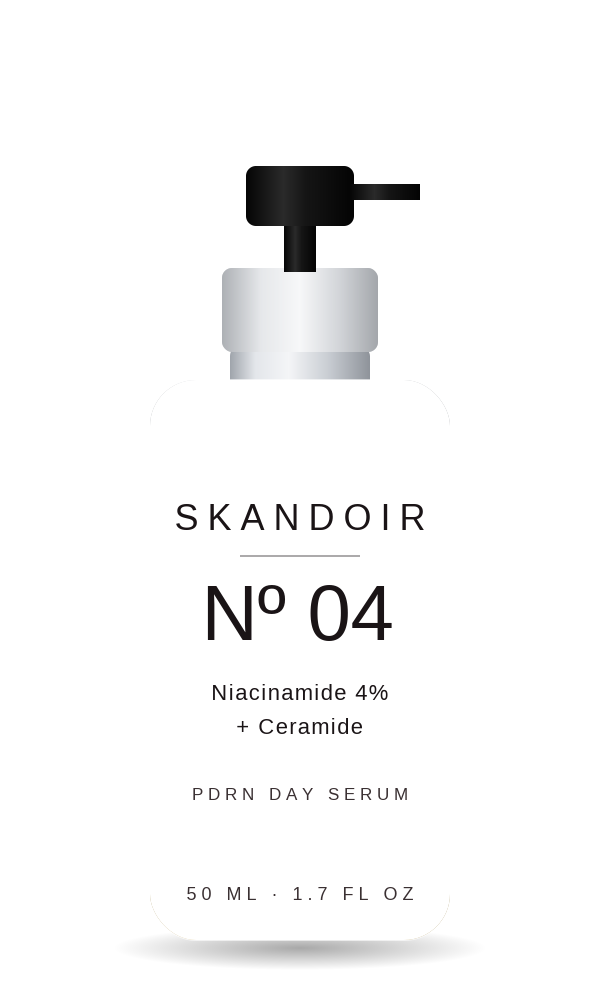
Yes. Many routines pair them. In the Skandoir ritual, niacinamide is in the morning serum Nº 04 and copper peptide is in the night serum Nº 03.
Does copper peptide get into the skin?
Slowly. It is water-loving and the skin barrier is made of lipids. Lab studies on human skin show copper does move through over 48 hours. We make no penetration claim for Nº 03.
How long before I judge a copper peptide serum?
The published cosmetic studies ran 8 to 12 weeks. Use it nightly, patch test first, and judge comfort and texture in the first week and everything else after about three months.
Sources for this Copper peptide (GHK-Cu) in skincare article
- Pickart L, Margolina A. Review of the actions of the GHK-Cu peptide in the light of new gene data. International Journal of Molecular Sciences, 2018; 19(7):1987.
- Hostynek JJ, Dreher F, Maibach HI. Human skin penetration of a copper tripeptide in vitro as a function of skin layer. Inflammation Research, 2011; 60(1):79–86.
- Ogórek K, Nowak K, Wadych E, et al. Are We Ready to Measure Skin Permeation of Modern Antiaging GHK–Cu Tripeptide Encapsulated in Liposomes? Molecules, 2025; 30(1):136.
- Bossak-Ahmad K, Wiśniewska MD, Bal W, et al. Ternary Cu(II) Complex with GHK Peptide and Cis-Urocanic Acid as a Potential Physiologically Functional Copper Chelate. International Journal of Molecular Sciences, 2020; 21(17):6190.
- COSMILE Europe. Copper Tripeptide-1 — INCI detail (function: skin conditioning; origin: synthetic).
This page is educational and is not medical advice. Skandoir serums are cosmetics; they are not intended to treat any condition. For skin or hair disease, see a doctor.
Last reviewed: 5 November 2026