What a face serum is — and how it differs from a moisturiser
A serum is a light, concentrated layer built to carry a few chosen actives. A moisturiser is a heavier layer built to hold water in and soften the surface.
Serums are usually water-based gels or fluids, used in small amounts on clean skin. Moisturisers carry more oils and film-formers, so they sit on top and slow water loss. In a humid Indian summer, many people find a serum plus a light gel moisturiser is enough; in air-conditioned rooms or the drier months, a richer cream may feel better.
A serum does not replace sunscreen. By day, sunscreen is the step that matters most.
The skin barrier: ceramides, cholesterol, fatty acids and TEWL
The outermost layer of skin, the stratum corneum, is often pictured as bricks and mortar. The bricks are flattened dead cells. The mortar is a lipid matrix made of ceramides, free fatty acids and cholesterol "in an about equimolar ratio" — roughly equal parts — and a 2020 review describes that lipid matrix as almost entirely responsible for how well the barrier works (Schmitt & Neubert, Skin Pharmacol Physiol, 2020).
When the barrier is working, water leaves the skin slowly. Dermatologists measure this as TEWL — transepidermal water loss. Higher TEWL usually means a stressed barrier: tightness, stinging, flaking, or skin that reacts to products it used to tolerate.
- Heat and sweat invite frequent washing and harsh cleansers, which strip lipids.
- Air-conditioning dries the air indoors, even in humid cities.
- Stacking strong actives — acids, scrubs, several new serums at once — is the most common cause of a stressed barrier we see.
Why gentleness matters more on Indian skin
Skin with more melanin tends to answer inflammation with colour. After a pimple, a rash, a burn or a reaction to an irritating product, a darker mark can stay behind. Dermatologists call this post-inflammatory hyperpigmentation, or PIH.
A widely cited review notes that PIH "tends to affect darker skinned patients with greater frequency and severity", lists irritant reactions and cosmetic procedures among its causes, and says marks in the upper skin may take months to years to fade on their own (Davis & Callender, J Clin Aesthet Dermatol, 2010). The same review calls daily broad-spectrum sun protection an essential part of care, and warns that irritating treatments can themselves cause or worsen marks.
The practical lesson
For Indian skin, a routine that never stings is often the routine that keeps tone looking even. Stronger is not better if it leaves the skin red. The aim is calm, comfortable skin and an even-looking tone over time — not a change in your natural colour.
Persistent marks, acne or any skin condition deserve a dermatologist's opinion. Serums are cosmetics, not treatments.
Morning: a barrier serum, then broad-spectrum sunscreen
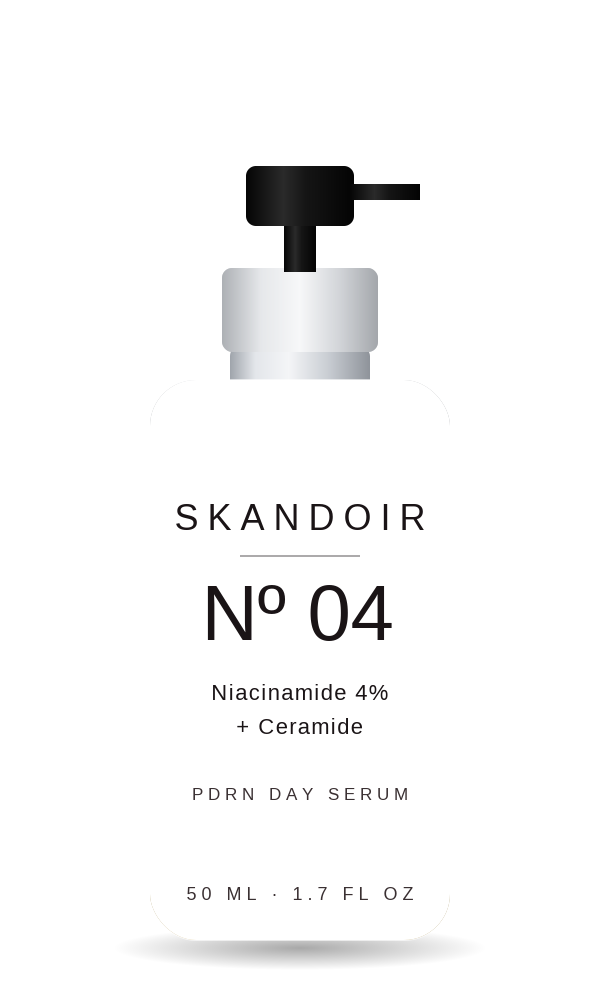
The morning job is defence: keep water in, keep the barrier comfortable, and protect against the sun. Skandoir's morning serum is Nº 04 · Niacinamide 4% + Ceramide, a pump-dispensed gel serum.
- Niacinamide. In a 2000 study, nicotinamide (another name for niacinamide) increased ceramide and other lipid production in cultured skin cells, and applied to dry skin it raised ceramides and free fatty acids in the outer layer and lowered TEWL (Tanno et al., Br J Dermatol, 2000). That is what the study found; it is not a promise about any one serum.
- Ceramides NP, AP and EOP with cholesterol and phytosphingosine. Nº 04 carries three ceramides together with cholesterol — the same families of lipids that make up the barrier's mortar.
- Ectoin. A small water-binding molecule first found in microbes that live in salty, harsh places. A 2022 systematic review of creams containing ectoin, in people with dry, barrier-impaired skin, describes it as well tolerated (Kauth & Trusova, Dermatol Ther, 2022).
- Pea and quinoa seed extracts round out a light, non-sticky gel suited to humid mornings.
Finish with a generous layer of broad-spectrum sunscreen, every morning, including cloudy days and days indoors near windows. Reapply when you are outdoors for long or sweating. No serum can do this job for you.
Night: copper peptide, PDRN, adenosine and bakuchiol
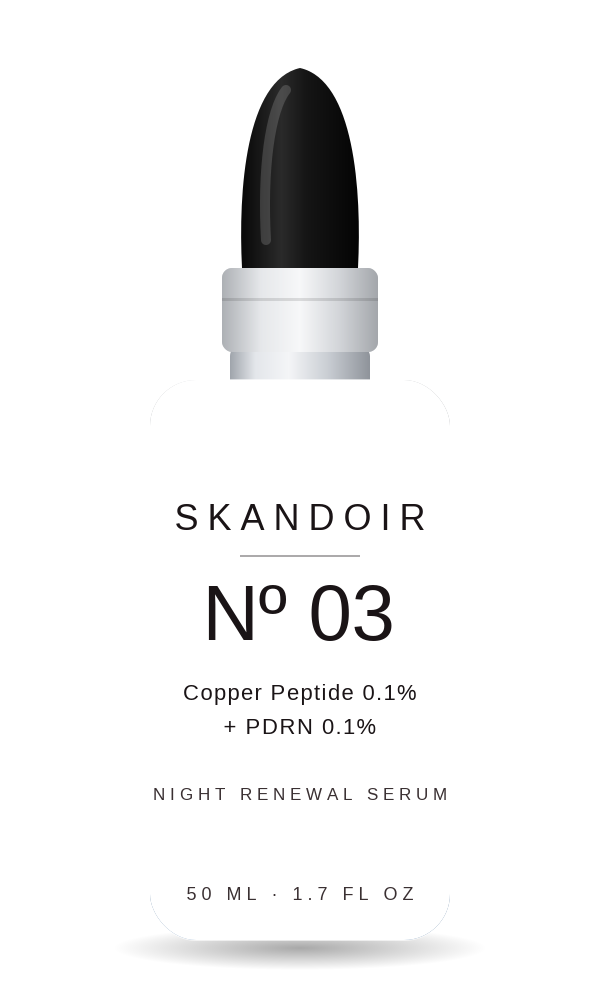
Night is when the skin is not dealing with sun or sweat, so it is the time for care-focused actives. Skandoir's night serum is Nº 03 · Copper Peptide 0.1% + PDRN 0.1%, a water-light dropper serum.
- Copper peptide (Copper Tripeptide-1, GHK-Cu) — a skin-conditioning tripeptide holding one copper ion; it is what gives the serum its natural blue. The full story is in our copper peptide guide.
- PDRN (Sodium DNA) — purified DNA fragments used in cosmetics as a skin-conditioning ingredient, with early evidence as a serum ingredient. See our PDRN guide.
- Adenosine — a skin-conditioning ingredient long used in Korean skin science for smoother-looking skin.
- Bakuchiol — a plant-derived ingredient studied as a gentler alternative to retinol.
- Glycerin and betaine — humectants that hold water in the skin.
What the bakuchiol trial found
In a 12-week randomised, double-blind study of 44 adults with facial photo-ageing, one group used a 0.5% bakuchiol cream twice daily and the other a 0.5% retinol cream once daily. Both groups saw significant reductions in wrinkle surface area and hyperpigmentation, with no statistically significant difference between them, and the retinol group reported more scaling and stinging. The authors concluded bakuchiol "is promising as a more tolerable alternative to retinol" (Dhaliwal et al., Br J Dermatol, 2019).
It was one small study, in one population, of a cream at a stated strength — not of Nº 03. We cite it because tolerability matters for skin that marks after irritation.
The routine, step by step
| Step | Morning | Night |
|---|---|---|
| 1 | Gentle cleanser or plain water, pat dry | Gentle cleanser; remove sunscreen fully, pat dry |
| 2 | Nº 04: 1–2 pumps over face and neck | Nº 03: 4–5 drops over face and neck |
| 3 | Light moisturiser if your skin wants it | Moisturiser — gel in humid months, cream if dry |
| 4 | Broad-spectrum sunscreen, generously | — |
- Thinnest to thickest. Serum on clean, dry skin, then moisturiser, then sunscreen.
- Give each layer a minute. Let the serum settle before the next step so it does not pill.
- Introduce one product at a time. Start Nº 04 first for two weeks, then add Nº 03 every other night before going nightly.
- Keep the neck in. It sees the same sun.
Your scalp has its own morning and night steps too. All Skandoir serums are side by side on Skandoir serums compared.
What not to mix, patch testing, and patience
Keep apart
- Copper peptide and ascorbic acid in the same step. Acidic vitamin C can interfere with the copper complex. If you use a vitamin C serum, keep it to the morning and Nº 03 to the night.
- Strong acids and peels on the same night as Nº 03. Glycolic, salicylic or high-strength exfoliants plus new actives is a common route to irritation — and, on deeper skin, to marks. Alternate nights, or pause acids while you start.
- Another retinol product on top of bakuchiol. Not needed while you are starting. Add nothing new for the first few weeks.
Patch test first
The American Academy of Dermatology suggests applying a new product to a small area, such as the inside of the elbow, twice a day for seven to ten days. If there is no redness, itching or swelling, you can start using it; if a reaction appears, wash it off and stop (AAD).
Give it 8 to 12 weeks
Comfort and texture can feel different within days. Anything else takes longer: the studies above ran for weeks to months. Take a photo in the same light on day one and judge after two to three months, not two weeks.
In heat and humidity
- Choose gel or fluid textures; both Skandoir face serums are water-based gels.
- Use less, not more — a thin even layer absorbs better than a heavy one.
- Blot sweat rather than scrubbing, and cleanse gently at night.
Pregnant or breastfeeding? Ask your doctor before starting any new active, including bakuchiol and other night serums.
Face serum routine for Indian skin: questions and answers
What is the best face serum routine for Indian skin?
A short one: a barrier-supporting serum in the morning under broad-spectrum sunscreen, and one care-focused serum at night, each followed by a moisturiser if your skin wants it. Gentleness matters because deeper skin tones can mark after irritation.
Should I use a serum or a moisturiser?
They do different jobs. A serum is a light layer of concentrated actives; a moisturiser holds water in. In humid weather many people use a serum with a light gel moisturiser; in drier months a richer cream may suit better.
Can I use niacinamide and copper peptide together?
Yes, they are commonly paired. In the Skandoir routine, niacinamide is in Nº 04 for the morning and copper peptide is in Nº 03 for the night.
What should I not mix with copper peptide?
Avoid applying it in the same step as an acidic vitamin C (ascorbic acid) serum, and avoid strong acids or peels on the same night while you are starting.
Is bakuchiol a good alternative to retinol?
A 2019 randomised, double-blind trial of 44 adults found a 0.5% bakuchiol cream comparable to a 0.5% retinol cream for wrinkle area and hyperpigmentation over 12 weeks, with less scaling and stinging. It was one small study, not a test of any Skandoir product.
Can I use these serums during pregnancy?
Ask your doctor before starting any new active during pregnancy or breastfeeding, including bakuchiol.
Sources for this Face serum routine for Indian skin article
- Dhaliwal S, et al. Prospective, randomized, double-blind assessment of topical bakuchiol and retinol for facial photoageing. British Journal of Dermatology, 2019; 180(2):289–296. doi:10.1111/bjd.16918
- Davis EC, Callender VD. Postinflammatory hyperpigmentation: a review of the epidemiology, clinical features, and treatment options in skin of color. Journal of Clinical and Aesthetic Dermatology, 2010; 3(7):20–31.
- Tanno O, Ota Y, Kitamura N, Katsube T, Inoue S. Nicotinamide increases biosynthesis of ceramides as well as other stratum corneum lipids to improve the epidermal permeability barrier. British Journal of Dermatology, 2000; 143(3):524–531. doi:10.1111/j.1365-2133.2000.03705.x
- Schmitt T, Neubert RHH. State of the Art in Stratum Corneum Research. Part II: Hypothetical Stratum Corneum Lipid Matrix Models. Skin Pharmacology and Physiology, 2020; 33(4):213–230. doi:10.1159/000509019
- Kauth M, Trusova OV. Topical Ectoine Application in Children and Adults to Treat Inflammatory Diseases Associated with an Impaired Skin Barrier: A Systematic Review. Dermatology and Therapy, 2022; 12:295–313. doi:10.1007/s13555-021-00676-9
- American Academy of Dermatology. How to test skin care products.
This page is educational and is not medical advice. Skandoir serums are cosmetics; they are not intended to treat any condition. For skin or hair disease, see a doctor.
Last reviewed: 5 November 2026