What ectoin is: an extremolyte from Halomonas elongata
Ectoin is a small, ring-shaped molecule that bacteria living in very salty places build up inside their cells to stay alive. Scientists call molecules like this extremolytes or compatible solutes.
When the water outside a cell is saltier than the water inside, the cell starts to lose water. Halophilic (salt-loving) bacteria answer by filling their cells with ectoin. It balances the pressure without disturbing the proteins and membranes inside. A 2020 review describes it as shielding "proteins, cell membranes, and human tissues" from stresses such as heat and dryness (Becker & Wittmann, 2020).
Chemically, ectoin is a cyclic tetrahydropyrimidine. It is amphoteric and zwitterionic: it carries a positive and a negative charge at the same time. That double charge, rather than any single bond, is what researchers link to its strong pull on water (Graf et al., 2008). On an ingredient list it appears simply as Ectoin.
How ectoin is made: bacterial milking and osmotic shock
Commercial ectoin is not extracted from a plant or synthesised from petrochemicals. It is fermented. The workhorse is Halomonas elongata, a halophilic bacterium, and the classic process is called bacterial milking (Becker & Wittmann, 2020).
- Salt up. The bacteria grow in a broth of about 15% salt, and ectoin builds up inside their cells.
- Shock. The salt is dropped to about 3%. Water rushes in, and the cells release ectoin into the broth to protect themselves.
- Purify. The broth is filtered, desalted, purified by chromatography, dried and crystallised.
The same review notes the strain used is not genetically modified, and that the very salty broth corrodes ordinary stainless-steel tanks and adds wastewater cost. That is one reason ectoin is a premium raw material, and why researchers are now testing low-salt production in other microbes (Becker & Wittmann, 2020).
Ectoin is also used outside cosmetics, in over-the-counter medical products such as nasal sprays and inhalation fluids (Becker & Wittmann, 2020). Those are different products with different rules. Nothing here should be read as a medical use for a serum.
How ectoin works: water structuring, preferential exclusion and the hydration shell
Most moisturising ingredients work by attracting water. Ectoin does that too, but researchers describe something more specific: it organises the water around it.
- A hydration shell. Computer simulations found that each ectoin molecule holds about seven water molecules by hydrogen bonds, all within roughly half a nanometre of its surface (Smiatek et al.).
- Preferential exclusion. Ectoin tends to stay out of direct contact with proteins and membranes. It stays in the surrounding water instead, which leaves a well-hydrated layer around the protein's surface (Smiatek et al.).
- Stable water clusters. In simulations heated to high temperatures, water clusters around ectoin held together, while clusters around glycerol broke apart and the water drifted away (Graf et al., 2008).
A 2021 laboratory study looked at this in real skin. Pieces of the outer layer (the stratum corneum) were soaked in ectoin solutions. Ectoin appeared to loosen and hydrate keratin. After drying, treated skin thinned by about 2%, against about 6% without ectoin, a sign that it held on to more water (Bow et al., 2021). This was donor tissue in a laboratory, with very small samples. It helps explain the idea; it is not a result on living faces.
What the human ectoin studies show: hydration, barrier and atopic skin
- 2008 · Germany
A review reports that an oil-in-water emulsion with ectoin, applied to people's skin, was followed by lower transepidermal water loss (TEWL), suggesting a stronger barrier. The same work found ectoin protected cell membranes from damage by surfactants in the laboratory (Graf et al., 2008).
- 2010 trial · 2014 paper
A randomised, double-blind, multi-centre trial in 65 adults with mild to moderate atopic dermatitis. Each person used an ectoin cream on one patch and a non-steroidal barrier cream on a matching patch, twice daily for 28 days. The ectoin cream was well tolerated and worked as well as the comparison cream on the scored outcomes (Marini et al., 2014).
- 2021 · USA
The laboratory stratum corneum study above: ectoin hydrated keratin and slowed water loss during drying (Bow et al., 2021).
- 2022 · Systematic review
A review of six clinical studies, five in atopic dermatitis. Formulas with 5.5–7.0% ectoin improved dryness, and with it itch and dermatitis scores, and were well tolerated for up to four weeks, including in infants and children (Kauth & Trusova, 2022).
In plain words: across the published human work, ectoin creams were linked to better hydration and barrier readings, and they were gentle. The strongest data come from people with dry, inflamed, barrier-impaired skin, using creams with 5.5–7% ectoin.
Atopic dermatitis is a medical condition, and these studies are described here as research history. Skandoir serums are cosmetics. They are not intended to treat eczema or any skin condition. If your skin is inflamed, cracked or itchy for weeks, see a dermatologist.
The limits of ectoin: dose, pollution claims and small studies
Encouraging is not the same as proven
The studies are few and small. The 2022 systematic review found only six clinical studies that met its criteria, out of 230 references screened (Kauth & Trusova, 2022). The best-known trial had 65 people.
The strength in those studies was high. The atopic-skin creams used 5.5–7% ectoin. A serum that lists ectoin near the end of its ingredients is not repeating those studies, and should not borrow their results.
The pollution research is mostly about lungs. You will often read that ectoin "protects against pollution". The best-known work used carbon nanoparticles as a model of air pollution, in lung cells and in animals: ectoin blocked a ceramide-driven inflammatory signal and reduced lung inflammation (Peuschel et al., 2012). That is real science, but it was not done on facial skin.
Mechanism is not outcome. Simulations of water shells and soaked tissue in a laboratory explain why ectoin is interesting. They do not tell you what a particular bottle will do on your face.
So what can an ectoin serum honestly do? Based on what is published: ectoin is a gentle, water-structuring ingredient that supports skin hydration and the barrier. Treat claims that go further, such as reversing ageing or blocking pollution, with care.
Ectoin next to ceramides and niacinamide in Skandoir Nº 04
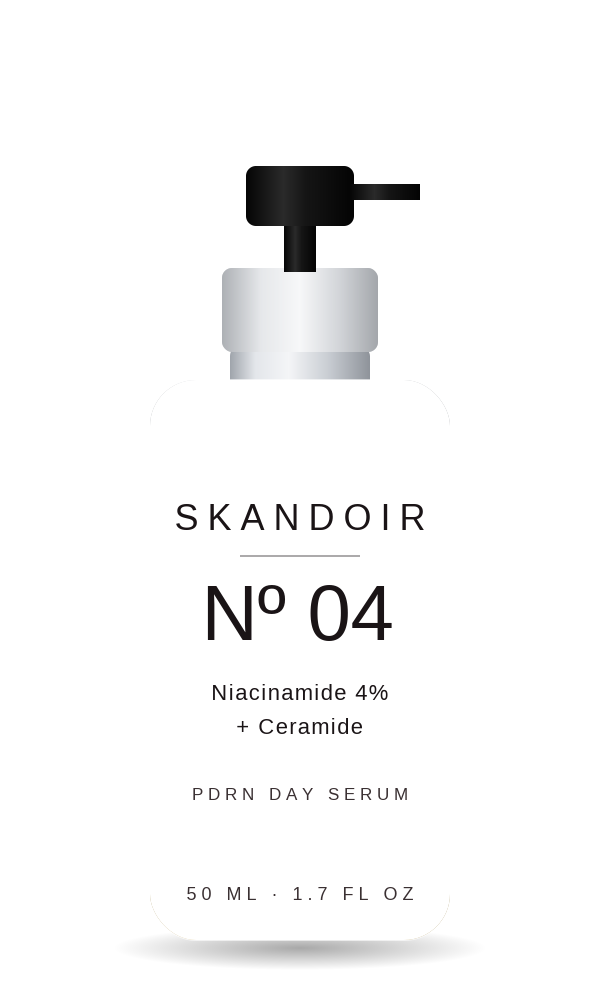
In Nº 04 · Niacinamide 4% + Ceramide, the Daily Barrier Serum, ectoin is a supporting ingredient. It is not the headline and we do not state a strength for it. It sits in the ingredient list after the preservatives, alongside the barrier lipids.
| Layer of the formula | On the INCI list | What it is there for |
|---|---|---|
| Headline active | Niacinamide (4%, as in the name) | A vitamin B3 form, widely used in barrier and tone-evening care |
| Barrier lipids | Ceramide NP, Ceramide AP, Ceramide EOP, Cholesterol, Phytosphingosine | The kinds of lipids found between the cells of the skin's outer layer |
| Water management | Ectoin | Holds and organises water around itself |
| Plant extracts | Pea seed extract, Quinoa seed extract | Supporting skin-conditioning extracts |
Why the three belong together
- Different jobs. Ceramides and cholesterol work on the lipid layer between skin cells. Ectoin works on water. Niacinamide is the active the serum is built around. None of them repeats another.
- Gentle company. Ectoin's published record is one of good tolerance, which suits a serum worn every morning.
- Built for Chennai mornings. Nº 04 is a light, pump-dispensed serum that goes on before sunscreen, so the barrier care sits under your daily protection, not instead of it.
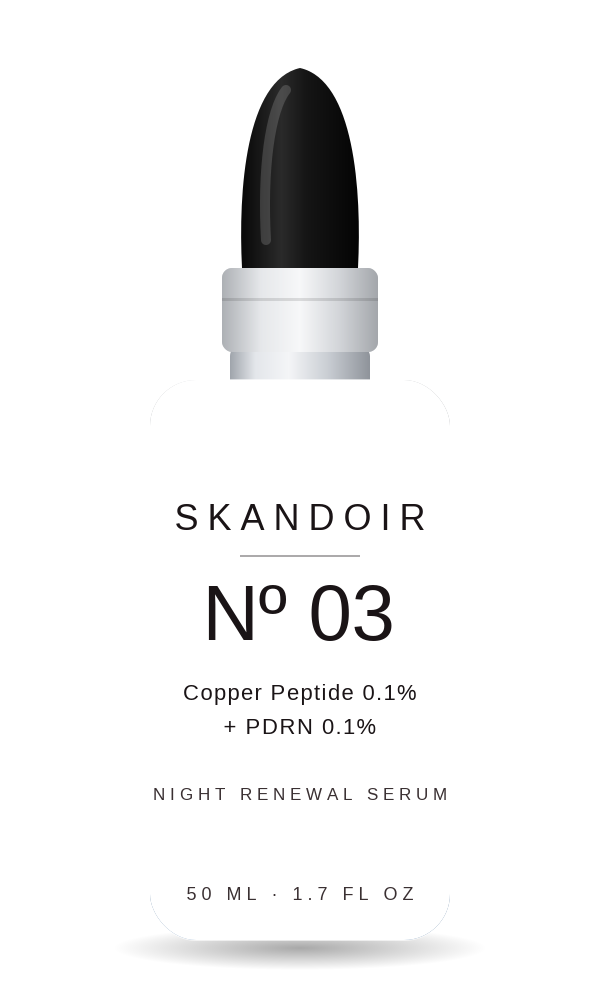
Nº 04 comes in 50 ml frosted silver glass with a pump. Proposed MRP ₹2,600, inclusive of all taxes; launch expected January 2027. At night, the ritual moves to Nº 03 · Copper Peptide 0.1% + PDRN 0.1%. All the serums are side by side on Skandoir serums compared, and more molecules are explained in The Skandoir Lab.
How to judge an ectoin serum
Whichever brand you buy, these questions separate a careful formula from a trend label.
- Where is ectoin on the list? Near the top suggests a meaningful amount; near the end means a supporting role. Both can be honest, as long as the claims match.
- Do the claims match the studies? Hydration and barrier support have published human data behind them. "Anti-pollution shield" mostly rests on lung and laboratory work.
- What else carries the barrier? Ectoin works with water. Look for barrier lipids, such as ceramides and cholesterol, if your skin feels tight or dry.
- Is a strength stated, and is it the brand's own test or a study's? A study's number on another product's cream is not a result for this bottle.
- Will you wear it every day? Barrier care works through steady use. A texture that sits well under sunscreen matters more than a long list of actives.
Ectoin in skincare: questions and answers
What is ectoin in skincare?
Ectoin is a small molecule that salt-loving bacteria make to survive drying, salt and heat. In skincare it is used as a hydrating, barrier-supporting ingredient. On a label it appears as Ectoin.
Is ectoin natural?
It is made by fermentation. Bacteria such as Halomonas elongata are grown in very salty broth and then given an osmotic shock, which makes them release ectoin. The process is called bacterial milking.
Is ectoin better than hyaluronic acid or glycerin?
They work differently, and no head-to-head human study on everyday skin settles it. In computer simulations, water held around ectoin stayed in place longer than water around glycerol. Many good formulas use more than one hydrating ingredient.
Does ectoin protect skin from pollution?
The best-known pollution research used model particles in lung cells and animals, not facial skin. It is promising science, but it does not prove a protective effect from a serum.
Is ectoin safe for sensitive skin?
Published studies, including some in infants and children with atopic dermatitis, found ectoin creams well tolerated for up to four weeks. Patch-test any new product, and see a dermatologist for a persistent skin condition.
Which Skandoir product contains ectoin?
Ectoin is in Skandoir Nº 04 Daily Barrier Serum (Niacinamide 4% + Ceramide), where it supports niacinamide and the ceramide-cholesterol complex. It is a supporting ingredient, and no strength is stated for it.
Sources for this Ectoin in skincare article
- Graf R, Anzali S, Buenger J, Pfluecker F, Driller H. The multifunctional role of ectoine as a natural cell protectant. Clinics in Dermatology, 2008; 26(4):326–333.
- Marini A, Reinelt K, Krutmann J, Bilstein A. Ectoine-containing cream in the treatment of mild to moderate atopic dermatitis: a randomised, comparator-controlled, intra-individual double-blind, multi-center trial. Skin Pharmacology and Physiology, 2014; 27:57–65.
- Kauth M, Trusova OV. Topical ectoine application in children and adults to treat inflammatory diseases associated with an impaired skin barrier: a systematic review. Dermatology and Therapy, 2022; 12(2):295–313.
- Bow JR, Sonoki Y, Uchiyama M, Dauskardt RH. Ectoine disperses keratin and alters hydration kinetics in stratum corneum. Biochemistry and Biophysics Reports, 2021; 28:101134.
- Smiatek J, Harishchandra RK, Rubner O, Galla HJ, Heuer A. Properties of compatible solutes in aqueous solution. Biophysical Chemistry (doi:10.1016/j.bpc.2011.09.007); arXiv preprint 1010.4216.
- Becker J, Wittmann C. Microbial production of extremolytes: high-value active ingredients for nutrition, health care, and well-being. Current Opinion in Biotechnology, 2020; 65:118–128.
- Peuschel H, Sydlik U, Grether-Beck S, et al. Carbon nanoparticles induce ceramide- and lipid raft-dependent signalling in lung epithelial cells: a target for a preventive strategy against environmentally-induced lung inflammation. Particle and Fibre Toxicology, 2012; 9:48.
This page is educational and is not medical advice. Skandoir serums are cosmetics; they are not intended to treat any condition. For skin or hair disease, see a doctor.
Last reviewed: 5 November 2026