How hair sheds: the hair cycle and normal daily hair fall
Every hair on your scalp runs its own cycle: a long growing phase, a short transition, and a resting phase that ends with the hair falling out. Shedding is part of the design.
- Anagen · growing
About 85% of scalp follicles are here at any time, and the phase lasts roughly four years (DermNet).
- Catagen · transition
A brief changeover. Only a few hairs are in it at any moment (DermNet).
- Telogen · resting
About 15% of follicles, for roughly four months. A new hair forms beneath and pushes the old one out — that is the hair you find on your comb (DermNet).
The American Academy of Dermatology puts normal shedding at between 50 and 100 hairs a day (AAD). Long hair, oiling and wash day all make it look like more, because hairs that have already let go collect and come out together.
Common reasons for hair fall in India
Most heavy shedding has a cause you can name. These are the ones dermatologists describe most often, with notes on Indian conditions.
- Seasonal shedding. A Swiss study of 823 healthy women found the share of resting hairs was highest in summer, with a smaller rise in spring (Kunz et al., 2009). India's seasons are different, but the lesson travels: shedding can rise and fall through the year on its own.
- Shedding after illness, stress or a crash diet. Doctors call this telogen effluvium. A shock can push many growing hairs into the resting phase at once, and the shedding usually starts two to four months later, then settles over six to nine months (DermNet). Triggers include high fever, surgery, childbirth, high stress and losing a lot of weight quickly (AAD). A high fever such as dengue or typhoid is one example of that kind of shock.
- Iron, vitamins and thyroid. Iron deficiency and both under- and over-active thyroid are recognised triggers (DermNet). These are things a doctor checks with a blood test — iron stores, thyroid function and some vitamin levels, such as B12 and, often in India, vitamin D. They are not things to guess at or fix with a serum.
- Heat, humidity, hard water and build-up. Sweat, oil, styling products and hard-water minerals can leave a film on the scalp and make hair feel rough and look flat. A clean, comfortable scalp is the right starting point for any scalp care, though build-up on its own is rarely the whole story of heavy shedding.
- Tight styles. Tight buns, plaits, ponytails and extensions can pull hair out at the hairline over time. The AAD lists broken hairs around the forehead, a receding hairline, stinging or tenderness as warning signs, and warns that the loss can become permanent if the pulling continues (AAD).
- Pattern thinning. A gradually widening parting in women, or a receding hairline and thinning crown in men, is a different process from shedding: the hairs come back finer over the years. It runs in families and is a reason to see a dermatologist early.
When hair fall needs a dermatologist, not a serum
A cosmetic is not a diagnosis
See a dermatologist, rather than trying another product, if you notice any of these:
- Sudden round or patchy bald spots, in the scalp, beard or eyebrows.
- Shiny, smooth or scarred-looking skin where hair used to be.
- Pain, burning, itching, redness or scaling on the scalp.
- Heavy shedding that has not settled after about three months, or that keeps coming back.
- A widening parting or receding hairline that you can see changing.
- Other signs of being unwell — tiredness, weight change, irregular periods.
The AAD notes that a dermatologist can tell apart hair loss, excessive shedding, or both, and that earlier care generally leads to better outcomes (AAD). Medical hair loss is treated by doctors. A cosmetic scalp serum can sit alongside their advice, but it is not a substitute for it — ask your dermatologist before adding one.
Scalp environment basics: what scalp care can do
What a cosmetic can honestly offer is a scalp that is clean, calm and comfortable, and hair that looks and feels healthier. That is worth doing well.
- Wash often enough for your weather. In Chennai heat, a sweaty or oily scalp may need washing every two or three days. Wash the scalp, not just the lengths.
- Keep heavy oils off the scalp for long periods. A pre-wash oil on the lengths is a ritual many enjoy. Left on the scalp for days in humid weather, it adds to build-up.
- Be gentle with wet hair. Pat dry, detangle with a wide-tooth comb, and let the roots dry before tying hair up.
- Loosen your styles. Change where the ponytail or plait sits and give the hairline breaks (AAD).
- Eat enough. Very low-calorie diets are a known trigger for shedding (DermNet).
What published research says about cosmetic scalp actives
Three ingredient families come up again and again in scalp serums. Here is what the studies found — described as what those studies found, and nothing more.
Adenosine 0.75% lotion
A 2020 systematic review pulled together randomised trials of topical adenosine, totalling 260 participants (Ke et al., 2020). Three of them used a 0.75% leave-on lotion twice a day: 27 Japanese women followed for 12 months, 101 Japanese men for 6 months, and 38 Caucasian men for 6 months. In these trials the adenosine groups ended with a higher proportion of thick hairs than the comparison groups, and no adverse events were attributed to the lotion. In the women's trial, the difference in dermatologists' ratings was not seen at 6 months, only at 12. The review concluded that adenosine "may be effective in increasing thick hair ratio" and asked for larger, longer studies. One of the trials was funded by the lotion's manufacturer. The Skandoir Lab has a full article on adenosine and these trials.
Caffeine on the scalp
In a German laboratory study, scalp biopsies were kept alive in culture: caffeine at very low concentrations offset the slowdown testosterone caused in the follicles, and on its own increased their proliferation in the dish (Fischer et al., 2007). A separate study on volunteers found caffeine from a shampoo reached the blood through the hair follicles within minutes, faster than through the skin between them (Otberg et al., 2007). Lab dishes and absorption tests are not the same as visible results on a head; they explain why caffeine is used, not what a bottle will do.
Redensyl™-type larch and green-tea extracts
Redensyl™ is a branded blend built on larch-wood and green-tea extracts with glycine. A 2025 review in the International Journal of Trichology, by an Indian dermatologist, lists it among newer topical options and describes a pilot study in 26 men over three months and a combination study in 41 people over 24 weeks (Int J Trichology, 2025). The review calls the evidence for these ingredients promising but preliminary: small samples, few proper comparison groups, mostly combination products, and studies sponsored by manufacturers.
These studies looked at people with diagnosed conditions or at tissue in a lab. Skandoir serums are cosmetics; they are not intended to treat hair loss, and nothing above is a promise about any product.
How to judge a scalp serum for hair fall
- Leave-on, not rinse-off. A scalp active has to stay on the scalp. In a shampoo or a rinse-off mask it is washed away within minutes. Rinse-off products are for cleansing and conditioning.
- A light vehicle. Look for a water-based lotion or mist that dries clear. In humid weather, a heavy oil sits on the scalp, attracts sweat and dust, and makes daily use unlikely.
- Strengths on the label. "With adenosine" or "with caffeine" can mean a trace. The published adenosine trials used 0.75%; a serum built on that research should say its strength.
- A full ingredient list. Read it, not just the front. The order and the names tell you what is really there.
- Patience: three to six months. Hair runs on long cycles. The published adenosine trials ran six to twelve months. Judge comfort and texture in week one, and everything else after three to six months of daily use.
- Patch test first. Apply a little behind the ear or on the inner arm and wait 24 to 48 hours. Stop if you see redness, itching or stinging.
- No promises of cures or quick results. A cosmetic that promises to stop hair fall in weeks is promising more than any cosmetic can.
A simple day and night scalp routine
Skandoir built its two scalp serums around the format of the published adenosine research: 0.75%, leave-on, twice a day — split into a morning mist and a night serum so neither feels like a chore.
| When | Product | How |
|---|---|---|
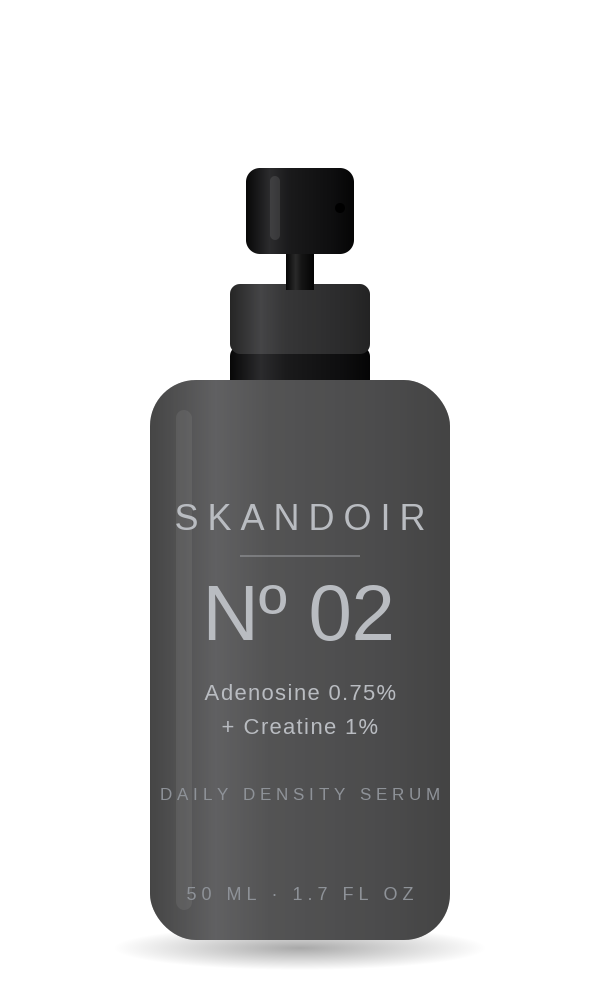
| Morning | Nº 02 · Adenosine 0.75% + Creatine 1% — Day Scalp Mist | Part dry hair in sections and mist the scalp at the roots. Massage lightly. No rinse. |
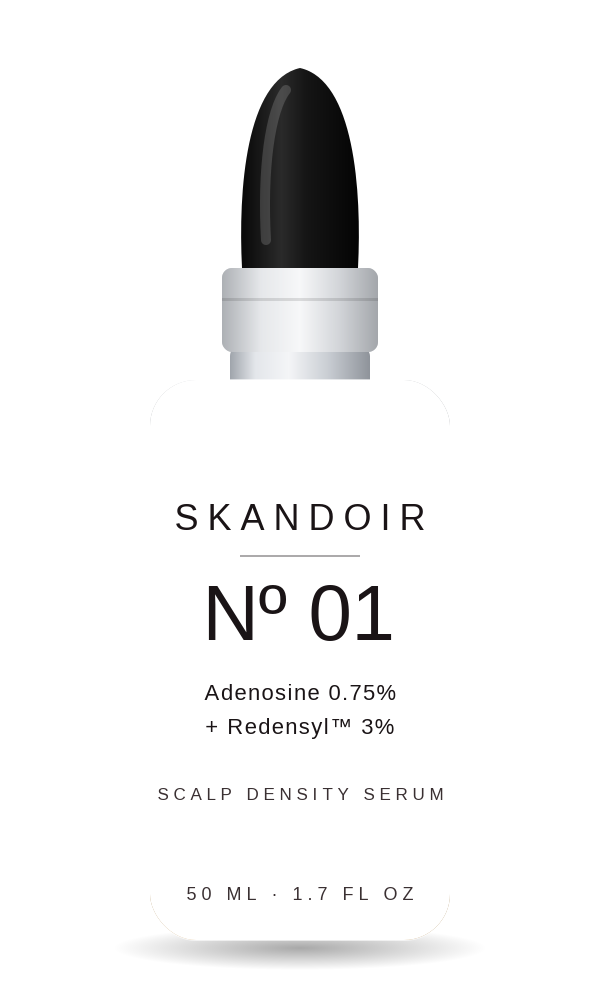
| Night | Nº 01 · Adenosine 0.75% + Redensyl™ 3% — Night Scalp Serum | Apply with the dropper along your partings on a dry scalp. Massage for a minute. Leave on overnight. |
| Wash day | BF-01 Blac Forest Protein Hair Masque | After shampoo, smooth through the lengths and rinse. Once the scalp is dry, carry on with Nº 02 or Nº 01 as usual. |
What is in them
- Nº 01 pairs adenosine with Redensyl™ (larch-wood and green-tea extracts with glycine), plus caffeine, copper tripeptide-1, sodium DNA and betaine, in a water, glycol and glycerin base. Frosted silver glass with a dropper, 50 ml.
- Nº 02 pairs adenosine with creatine in a fine water-and-glycerin mist with betaine. A full-black bottle with a mist sprayer, 50 ml.
- Both are leave-on and water-based, with no oils on the ingredient list — chosen for humid Indian weather.
- The masque is rinse-off and is for the lengths. It is not a scalp treatment.
Skandoir serums are cosmetics for scalp care and healthier-looking hair. They do not treat hair loss. If your shedding fits any of the signs above, see a dermatologist first. The full line is side by side on Skandoir serums compared; launch is expected in January 2027.
Scalp serum for hair fall: questions and answers
How much hair fall per day is normal?
The American Academy of Dermatology puts normal shedding at between 50 and 100 hairs a day. Wash days and long hair make it look like more, because loose hairs collect and come out together.
Why am I losing so much hair after fever or dengue?
A high fever or illness can push many hairs into the resting phase at once. The shedding usually starts two to four months later and settles over six to nine months. If it does not settle, see a dermatologist.
Does hair oil stop hair fall?
No study shows that oil stops shedding with an internal cause. Oiling can make lengths feel softer and reduce breakage when you comb. In humid weather, wash it off the scalp rather than leaving it on for days.
Can a scalp serum stop hair fall?
A cosmetic scalp serum cares for the scalp and can help hair look healthier. It cannot fix shedding caused by illness, low iron, thyroid problems or genetics. Those need a doctor.
How long should I use a scalp serum before judging it?
Give it three to six months of daily use. Hair runs on long cycles, and the published adenosine trials ran for six to twelve months.
When should I see a dermatologist for hair fall?
See one for sudden bald patches, shiny or scarred-looking skin, scalp pain or redness, a widening parting, or heavy shedding that has not settled after about three months.
Sources for this Scalp serum for hair fall article
- American Academy of Dermatology. Do you have hair loss or hair shedding?
- American Academy of Dermatology. Hairstyles that pull can lead to hair loss.
- Chang FC. Telogen effluvium (hair shedding). DermNet, New Zealand.
- Kunz M, Seifert B, Trüeb RM. Seasonality of hair shedding in healthy women complaining of hair loss. Dermatology, 2009; 219(2):105–110.
- Ke BN, Villena JPDS, Frez MLF. Efficacy and Safety of Topical Adenosine for Androgenetic Alopecia in Adults: A Systematic Review. Acta Medica Philippina, 2020; 54(3).
- Fischer TW, Hipler UC, Elsner P. Effect of caffeine and testosterone on the proliferation of human hair follicles in vitro. International Journal of Dermatology, 2007; 46(1):27–35.
- Otberg N, Teichmann A, Rasuljev U, et al. Follicular penetration of topically applied caffeine via a shampoo formulation. Skin Pharmacology and Physiology, 2007; 20(4):195–198.
- Chingshubam Bikash. Topical Alternatives for Hair Loss: Beyond the Conventional. International Journal of Trichology, 2025; 17(1):13–19.
This page is educational and is not medical advice. Skandoir serums are cosmetics; they are not intended to treat any condition. For skin or hair disease, see a doctor.
Last reviewed: 5 November 2026